Category Archives: Uncategorized

Building a Brand, Continuing a Journey of Lifelong Learning

I started this blog as a requirement for a graduate course taught by www.twitter.com/drbret while I was enrolled at University of Nevada Reno’s Executive Master of Business Administration (MBA) www.twitter.com/embaunr program from August 2020 – August 2022. This course in particular has been very fulfilling for me in many ways. As was the complement of the course curriculum, and succeeding in my personal growth. To be enrolled and to earn an MBA degree to further advance my career leadership skills.

I was able to be introduced to and to learn about several forms of online marketing through additional website development, social media sites I joined, and profiles that I produced to showcase my: personal story, life path, career experiences, and a connected professional brand that I selected to explore marketing to the public.

As you may know, my brand has focused on preventing injuries by consulting with communities to identify their biggest injury challenges and helping communities to select strategies and launch action plans through community engagement and capacity development. Using advocacy, awareness, buy-in & collaboration with private business, non-profits, faith-based & public sectors of the local community entities. Making it possible to strategically expand the reach of prevention strategies, through education, environment changes, enforcement changes, engineering & re-development of lands & buildings. In order to eliminate risk factors and to generate protective factors leading to a more resilient & higher quality of life community over time.

For example, creating single story, Americans with Disabilities Act (ADA) adapted design, and cost adjusted, to fixed income rental rates, housing options for seniors, with on-site exercise studio & physical therapy supported services. With the focus to assist senior tenants to prevent falls & extend their quality of life over their final 12 – 18 years. While the residents of this housing option would avoid falls injuries and hospitalizations. Which can be followed by costly intensive medical services recovery and result in earlier moves to assisted living care. With life expectancy shortened by 5 – 7 years, and earlier deaths.

Without this approach there is the risky alternative, possibly falls down stairs, a feature mismatched from being an ideal living environment for seniors. Or falls in the bathroom due to the lack of ADA grab bars or ADA toilet height riser attachment. Of a fall at the building entry also not adapted with a ramp, and having stairs that become difficult to maneuver as seniors age. All these risks, a challenge for seniors created simply from remaining in their long term residence, which lacks design change or adaptation for the purpose of aging in place. Because otherwise, without community planning, and advocacy, no better option may be available or studied or planned or designed to be available to allocate and link the resources to this vulnerable subset of the community population at risk of costly injuries.

See this is the purpose of what I learned in building a brand. Your presence on a website, on social media, with constant added and updated content perspectives that draw from the latest news, research, science advancement, peer reviewed articles and even results from legislative actions and government agency actions, are on display day and night and in all places where the internet exists 24/7. This is a powerful way to be discovered, to be known for your brand, and for your brand to be leading the kinds of ideas that create the changes you want to see. It also allows for continued improvement, for personal growth through knowledge attainment and continued lifelong learning by way of research. To develop content and share ideas with the public in a dialogue filtered through the social media site.

You know we talked about the invisible hand and how a brand developer does what is in their best interest, yet in many ways the social contract we adhere to by publicly posting our brand upholds ethical information sharing and value to others in the authenticity and emotional impact of the brand. The changes will also come from this positive energy and dialogue with the public and the followers of an online brand. The honesty & integrity are critical, avoiding misinformation a form of half truths and at times outright lies will be the only way to serve a brand’s purpose to invite the public to trust and share in the brand’s value.

This has been a great journey for me. I plan to continue to add content to this site to keep my brand going and expanding my reach as more people discover this website, my twitter account: www.twitter.com/Martin_NV_GA_AZ , or my LinkedIn account: https://www.linkedin.com/in/martin-stephens-ph-practice/ Thank you for visiting and reading my blog.
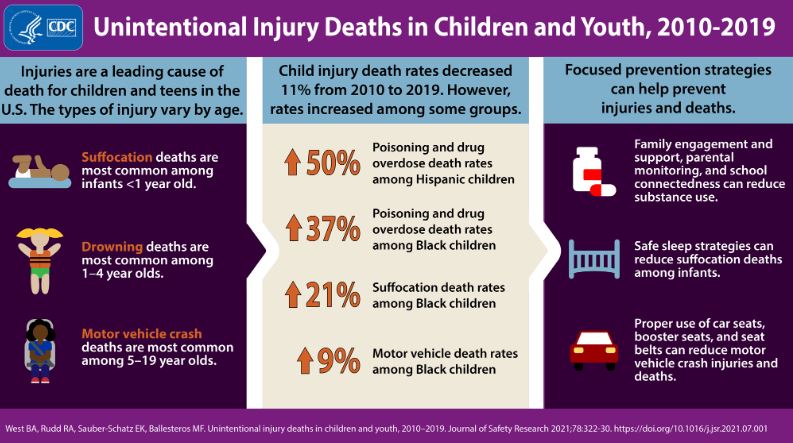
Child Injury Risks

For the very young children in the world their vulnerable risks to disease, injury and death are substantial. More than 7,000 children and teens from birth – 19 years of age died in 2019 because of unintentional injuries. That rate is about 20 deaths per day from causes like motor vehicle crash, suffocation, drowning, poisonings, fires and falls. These child injuries are preventable.

The data shows male children are more at risk, babies under one year old and teens in their 15 – 19 ages and races such as American Indians and Blacks are all at higher risk. A look at recent 10 years from 2010 to 2019 showed rate increases:

Suffocation deaths up 20% for infants overall & 21% among black children.

Motor vehicle crash rates up 9% for Black children while dropping by 24% among White children.

Poisoning deaths rose by 50% for Hispanic children, 37% for Black children as rates among White children decreased 24%

Drowning is the leading cause of injury death for children ages 1 – 4 years. Teaching kids of this age swim lessons and basic water safety skills are substantial prevention factors against drowning death.

These injuries are preventable and the prevention strategies in the pictograph right hand column above shows prevention strategies proven to work. The old saying goes, that an once of prevention is worth a pound of cure, and it for the most part still holds true. The funding needed for prevention is nearly always found to be substantially less when compared to the loss of young lives. The emergency department visits, the medical costs, the family loss and expanded societal loss of potential and productive years of life. All with impacts in the community with each child injury death.

Please advocate and support prevention strategies and raise awareness that child injuries are preventable, that prevention strategies are a sound investment in the community and will result in a better quality of life for the community as a whole especially if approached with equity, diversity and inclusive purposes for all children.

Homeless in America

The U.S. homeless problem has proven to be a persistent one. About 580,466 Americans were homeless in 2020 an increase of 12,751 or 2.2 percent over 2019 numbers tracked by the U.S. Department of Housing & Urban Development. These numbers are checked every year over 10 days in the month of January to capture what is called a Point-in-Time (PIT) estimate which provides a snapshot of sheltered and unsheltered homeless populations.

From 2010 – 2016 homelessness was on a steady decline but over the last four consecutive years the numbers trended higher through 2020. People of color are over-represented in the homeless populations compared with their percentage in the U.S. population as a whole. In 2021 during COVID there were fewer homeless and there was more effort in controlling disease transmission to support housing and COVID testing for homeless populations.

A recent study indicated more people over age 65+ are becoming homeless. Rising homelessness can harm entire communities, not just the persons experiencing homelessness. It increases financial and staffing demands on local governments and non-profit organizations who manage shelters and provide food assistance and other social services. Homeless persons also have higher prevalence of medical conditions such as 24 percent rate of asthma compared to 17 percent for a control group, 26 percent diabetes compared to 22 percent for the control group, lung disease 23 percent verses 11 percent for the control group, serious heart condition 45 percent verses 38 percent for the control group. Tobacco use rate was 63 percent verses 38 percent for the control group.

The prevention approach is of course to avoid loss of rental housing by protecting renters from drastic and unexpected price increases. It is much less expensive to keep housing than it is to rehouse persons once they have gone homeless. Next is the housing first approach that provides secure and supportive housing while the homeless person can get well from health conditions and can get services for mental health, substance use disorders and other underlying health conditions. Research has shown the street homeless persons that make this transition remain in stable housing and experience significant improvements in their wellness. These housing options are both more effective and less costly to operate than temporary shelters. Also avoids abuse of limited resources like emergency department visits coupled with institutional care space.

There is much work to do to reduce and solve America’s homeless challenges. Though communities can work with public health professionals to utilize the best practices and set up the necessary program structures to facilitate the transition of street homeless populations back to stable members of the community. Getting the persons well, ensuring access to basic needs of food, safety and security are met will go a long way to returning the persons to a productive and stable life from the desperation and decline of homelessness.

Child Passengers and Car Seats

In 2019 car crashes killed 731 children in America. For these passengers it was determined that 40 percent were not riding in a car seat or booster seat protective restraint. The proper use of a car seat for child passengers under age 12 is a critical protective factor when car crashes do occur. Car seats are a device that anchors the child passenger to the internal frame of the vehicle either with a traditional seat belt system routed through the car seat or using a newer designed system called LATCH Lower Anchors and Tethers for Children which uses metal hooks, adjustable tethers and anchor connectors located between the upper and lower cushions of the vehicle seats located in the 2nd row of the vehicle.

A study by the National Highway Traffic Safety Administration (NHTSA) found that 46 percent of car seats are not being used properly. Some of the errors with installations of these car seats include incorrect amount of recline, loose and inadequate anchoring, improper lap belt position were most observed for rear-facing car seats, forward-facing car seats, and booster seats. These results were derived from 24 regions across the U.S. and in evaluating 4,167 car seat observations.

For rear-facing car seats 16 percent did not have adequate recline setting. These seats are designed for newborns and their first year as passengers when the recline angle is important to support the infant’s head in an airway neutral position by having a design recline angle of 30 to 45 percent. When improperly installed it can cause the infant to rest in an airway restrictive position.

For forward-facing car seats 17 percent were installed loosely. This type of car seat has a harness and tether that limits the child’s forward movement during a crash and helps to absorb and dissipate the forces of the crash that would otherwise cause harm to the child both internally and externally. A loose installation is one where the seat can be moved side to side more than two inches when pushed or pulled at the belt path, because the belt is not properly tensioned to hold the seat tightly. The best practice is to anchor the seat securely so that it cannot move more than one inch laterally when pushed or pulled.

For high back and backless booster seats the purpose it to use the seat as a transition from a forward-facing car seat to the point where the child is tall enough to use a vehicle seat’s lap and shoulder belt system. Usually age 8 to age 12 when the child has outgrown the need for a booster seat. For these seat types 12 percent of installs had the lap belt path wrong where placed across the abdomen or the ribcage. The proper path is across the hips/thighs of the child which is strong bone verses soft abdomen tissue and muscle.

This study highlights how often car seats are either not used at all or are used in an improperly installed way. Fortunately there are child passenger safety technicians and many communities hold car seat check station events. These events allow drivers to bring their vehicle to the event with their children in car seats and allows the technician to inspect the seat conditions and installations and if needed conduct education and demonstrate corrections to improve installation and proper use of the car seat. If you have car seats and transport child passengers just to be sure research for a car seat check station in your community and schedule an inspection of your car seat to ensure you are using the seat as designed and installed properly to provide the intended protections to reduce the risk of injury should a motor vehicle crash occur.

Bad Signs for Motor Vehicle Crash Trends in U.S.

A data report just released shows from 2015 – 2019 that injuries and deaths from motor vehicle crash in the United States (U.S.) is not falling when compared with 28 other high-income economic nations. While MVC’s are preventable, the U.S. experiences an average of 36,791 deaths per year (101 deaths per day) from MVC’s. This is evident by the 2019 U.S. death rate being 2.3 times higher than the average rate of 28 other high-income nations. This is important because if the U.S. were to achieve the average population-based crash death rate, by lowering the incidence of crashes in the U.S. we could save approximately 20,517 lives and $280.5 million in medical costs per year in the U.S. The opportunities for progress and proven strategies that can save lives, prevent injuries, and avert medical costs exist.

Some of this injury challenge is unique to the U.S. For example, approximately 30% of U.S. MVC’s (>10,000 deaths a year) are attributed to alcohol-impaired driving. While 26 of the 29 nations in the study have 0.05 grams per deciliter (g/dL) Blood Alcohol Concentration (BAC) laws, based on evidence that the chosen higher 0.08 BAC laws in the U.S. are allowing for some impairment. In 2018 Utah became the first U.S. state to lower their law’s BAC to the 0.05 BAC level and in 4 years the results show substantial reductions in MVC’s, alcohol-involved MVC’s, and MVC deaths per mile driven.

The U.S. also has inconsistent levels of restraint use among drivers, passengers, and car safety seat use for under age 12 child passengers. In 2019, 47% of MVC’s where a passenger occupant was killed, the occupants killed were also not using a restraint device. The adoption and enforcement of primary seat belt laws that cover all vehicle seating positions could increase seat belt use, as will well-publicized and high-visibility law enforcement efforts. As of June 2022 only 20 states currently have a primary enforcement seat belt law in place that covers all seating positions.

Additionally, the U.S. has a driving speed risk factor that is less common in the other nations in the study. In fact in 27% of MVC’s that involve deaths, speeding is a contributing factor. Also, by reducing driving speeds fewer bicyclist and pedestrian deaths would occur each year in the U.S. Additional risk factors such as distraction, drug impairment, and fatigue also contribute to thousands of crash deaths every year.

There are proven strategies that the U.S. can implement and should use to address our leading risk factor causes of higher MVC’s: impaired driving, limited occupant restraint use and higher driving speeds. The Safe System is a proactive approach that prioritizes safety for all road users, accommodates for human error and human vulnerability, and incorporates road and vehicle designs that reduce crashes as well as deaths and injuries when crashes do occur. The Safe System approach highlights safe road users, safe vehicles, safe speeds, safe roads, and post-crash care as its five elements. These methods can be applied for any community to help make the roadways safer for all users and many other proven strategies as well. For more help with this public health challenge seek assistance from an injury prevention specialist.

Youth Violence Injuries

Youth violence occurs when youth intentionally use physical force or power to threaten or harm others. This public health problem is preventable. It takes several forms like bullying, fighting, threats with weapons, and gang-related violence to gain status. This problem is affecting youth ages 10 – 24 and they can be involved as victim, offender or witness to the violence. 

Every 24 hours in America 1,300 youth are treated in emergency departments for injuries sustained from physical assault. Some risk factors for youth violence include previous experience with violence, harsh discipline at home, social rejection, and poverty. Protective factors include developing problem-solving skills, positive relationships with adults and commitment to school. Some key prevention strategies are provide quality early education, promote family environments that support healthy development, strengthen youth skills, connect you to caring adults and activities, create protective community environments and intervene to lessen harms and prevent future risk.  

Given that the emergency department is where the medical system would encounter these youth needing medical treatment, it is a good opportunity to identify repeat visits by the same youth to determine patterns of violence or abuse. It is also a chance for a screening intervention by the medical provider and to guide the youth towards interventions with a counselor or social worker that can connect them at school or in the community with mentoring and settings to introduce prevention strategies as mentioned above. 

The similarities of youth violence are common across countries, but in the U.S. there are greater access to guns which does result in guns being brought to school by youth members. The Youth Risk Behavior Surveillance System (YRBSS) gathers data to examine the percentages of students in grades 9–12 who reported carrying a weapon on school property & anywhere during the previous 30 days. The survey asks students in grades 9–12 if they had carried a weapon such as a gun, knife, or club anywhere during the previous 30 days & if they had carried such a weapon on school property during the same time period. Overall, 13 percent of students reported having carried a weapon anywhere during the previous 30 days, including 6 percent who reported carrying a weapon anywhere on 6 or more days, 5 percent who reported carrying a weapon on 2 to 5 days, and 3 percent who reported carrying a weapon on 1 day. The survey found an average of 3 percent of students reported bringing a weapon on school property in previous 30 days. In every survey year male students in grades 9 – 12 report higher percentage of carrying weapons, for instance in 2019 males reported 19 percent to females 7 percent for carrying a weapon in the previous 30 days. This simply gives an idea of risk levels and commonality of weapons being present among the youth, but it will vary from community to community.

Youth violence is a year-to-year public health challenge in America. And there are strategies to help reduce and prevent youth violence that are proven to benefit any community to take steps to counter youth violence challenges. And there are professionals like me who are available to consult and help communities to create and implement a tailored plan to help address the youth violence challenge effectively. 

Seniors at Risk

Every year 3 million Americans over the age of 65 experience a fall. That is more than one out of every four seniors living in the U.S. One out of every five of these falls results in a broken bone or head injury. In fact 95% of hip fractures to seniors occur from falls and 800,000 seniors are hospitalized every year from falls. The total medical costs of this burden of injury in 2015 was more than $50 million.

There are a number of contributing factors that can put seniors at risk for falls. These risk factors can be modified to help prevent falls, they are:

Lower Body Weakness, Vitamin D Deficiency, Difficulties with Walking & Balance, Use of Medicines that Affect Balance, Vision Problems, Foot Pain or Poor Footwear, Home Hazards like Broken or Uneven Steps, Clutter affecting Walking or Throw Rugs that can cause tripping. Most falls involve several of these risk factors and healthcare providers can help a person to cut down on these risk factors.

For falls to be prevented it is important to get a fall risk screening by a medical provider. Get a medication review conducted by the provider or by a Pharmacist to determine if any could make you dizzy or sleepy and ask if vitamin D supplements are right for you. Active exercise that makes the legs stronger and improves balance is also helpful prevention. Have eyes and eyesight and eyewear prescriptions checked and updated once a year.

It is also important to make the home safe to in order to reduce fall risk. This means getting rid of things that could be tripped over or that limit space to move easily from room to room in the home. Adding securely wall anchored and stable grab bars at the bath tub or shower stall and the toilet. Add hand railings on both sides of stairways. Ensure good lighting in the home, night lights to assist seeing to get to the bathroom during the night. Store items that get used regularly in easy to access storage cabinets. Use non slip mats in the bath or shower floor to avoid falls while bathing.

Falls caused 34,000 deaths for seniors in 2019, the leading cause of injury death for this age group. And falls can cause seniors to lose their ability to live independently. Though falls do not have to be an inevitable reality because there are many preventative ways we already discussed that can prevent fall risks. So if you or someone you know is age 65 or over this is a good time to talk about fall risks with a medical provider and begin the screening and risk factors identification process to learn the proven prevention steps that reduce fall risks.

What Are ACEs?

ACEs are adverse childhood experiences which are potentially traumatic events we can be exposed to as children growing up. The first ACE study was conducted from 1995 to 1997 by Centers for Disease Control and Prevention (CDC) and the Kaiser Permanente healthcare company.

In the study 17,000 adults were asked about their childhood experiences including emotional, physical and sexual abuse; neglect and household challenges like parental separation, substance abuse, incarceration, violence and mental illness. Almost two-thirds of participants had at least one ACE and 20 percent noted 3 or more experiences. Researchers have found a link between more numerous ACE exposure and higher likelihood of risky behaviors, poor health and behavioral outcomes and premature death. ACEs can follow an intergenerational pattern where a person that experienced physical abuse as a child would be more likely to commit violent, including abusing or neglecting their own children, and being revictimized in the future.

ACEs are linked with increased risk for chronic diseases and behavioral challenges to include obesity, depression and alcoholism. The greater the number of ACEs experienced the greater risk of negative outcomes like performing poorly in school, being unemployed and develop high-risk behaviors such as smoking and drug use.

Though these challenges exist today prevention specialists work to increase resilience to help people create strengths and protective factors like stable relationships and strong family bonds to prevent violence and improve mental and behavioral health.

Do Seat Belts Affect Roadway Safety?

A seat belt is an effective safety tool that not only saves lives, but also significantly reduces the severity of the injury that a vehicle occupant may sustain if they were not wearing the device. The lap and shoulder belts prevent ejection from a vehicle and keep people from colliding with the vehicle interior during a crash. They are also designed to manage and absorb forces on the body during a crash.

For example, there were over 23,000 passenger vehicle occupants killed in 2020, and 51% were not wearing seat belts, which was 4% higher than in 2019. Seat belts being worn accounted for approximately 14,950 saved lives and could have saved another 2,500 people if other vehicle occupants were wearing seat belts in year 2017.

For drivers and front-seat passengers, using a lap and shoulder belt reduces the risk of fatal injury by 60% in an SUV, van or pickup and by 45% in a car. Seat belt use is lower among younger males. Among female drivers of all ages 93% of front seat occupants were observed using their belts, compared with 89% of males.

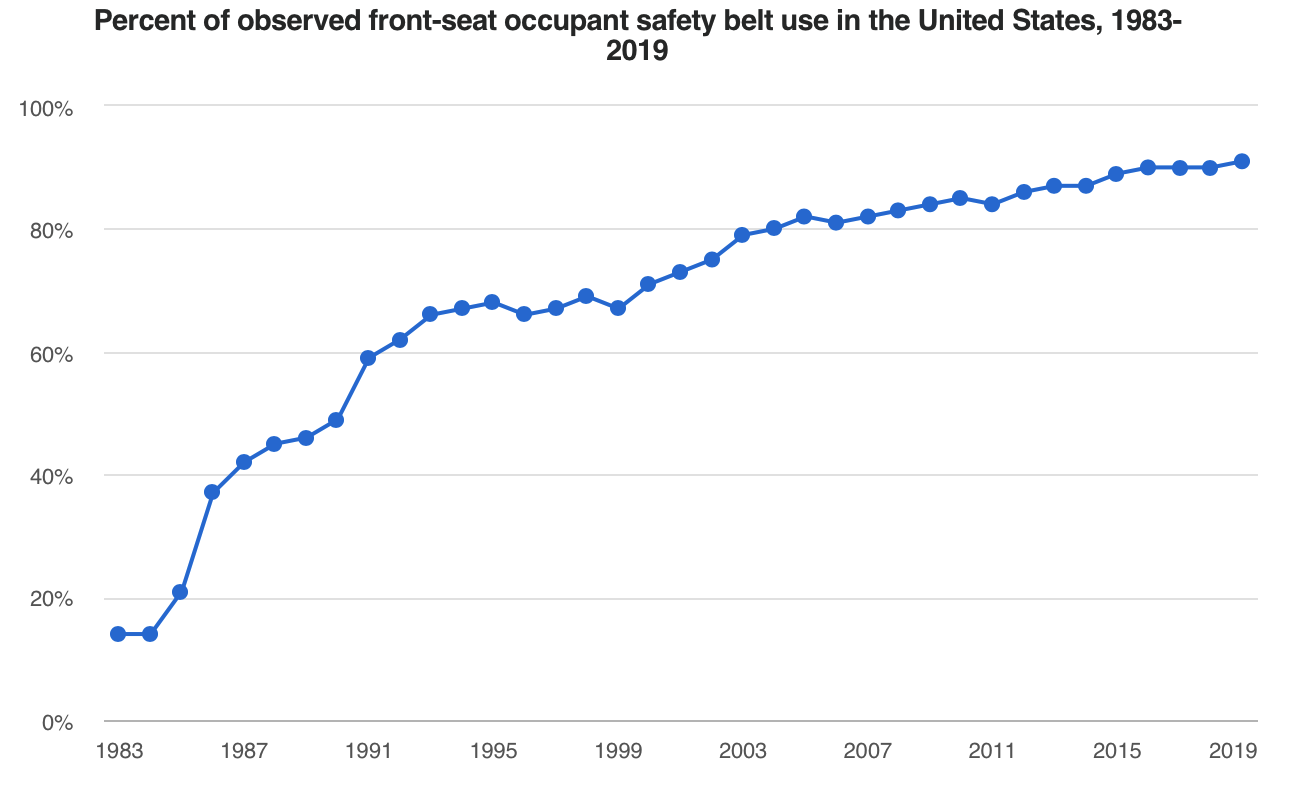
In 1983 seat belt use nationally was only at 14% and today use is at 92% nationally. The seat belt use rate has slowly rose to today’s level because states have adopted primary seat belt laws. These laws permit law enforcement officers to pull over vehicles where the driver or passengers are not wearing seat belts or properly using child safety seats as required by the law. These laws are most effective with routine enforcement efforts and with well-publicized awareness of enforcement. Unfortunately, there are only 34 states with primary seat belt laws. The evidence shows primary seat belt laws are more effective, and in 2019 were 6% more effective than secondary seat belt law states to get people to buckle up. The primary law has also shown a 7% lower fatality rate. If you live in a state with a secondary law it might be a good idea to advocate for a primary law upgrade with a letter to your State Representative because the results tend to indicate fewer fatalities. So please, buckle up out there and remind your passengers to wear their seat belts as well on every drive you take.

Opioids: Where do we start?

Do you ever find yourself reflecting about why you did a certain thing or made a certain choice after the fact? Maybe it felt like instinct, or maybe an impulsive move, maybe you didn’t think much about it since you’ve seen others around you make the same choice countless times before. This is okay, this is the way all humans behave. See, we each have biological and psychological characteristics which can make us vulnerable at times and resilient at other times when faced with behavioral health issues.

These biological and psychological characteristics exist in multiple contexts since we humans are social creatures and our society and social structures have many layers. So let’s explore that:

Risk factors are characteristics at the biological, psychological, family, community, or cultural level that precede, and are associated with, a higher likelihood of negative outcomes.

Protective factors are characteristics associated with a lower likelihood of negative
outcomes or that reduce a risk factor’s impact. Protective factors may be seen as positive countering events.

Assessing these risks and protective factors are important when considering substance use disorders. We should recall here the earlier blog, The Here & Now, https://prevention-1st.org/2022/06/15/the-here-now/ which demonstrated that for ages 1 – 44 in the U.S. in 2020, the most recent full year of evaluated data, showed that Opioids use disorder led to the highest source of injury related deaths.

To address the Opioids problem requires interventions that address raising protective factors, and identifying adverse risk factors.

Some risk and protective factors are fixed: they don’t change over time. Other risk and protective factors are considered variable and can change over time. Variable risk factors include income level, peer group, adverse childhood experiences (ACEs), and employment status.

Individual-level risk factors may include a person’s genetic predisposition to addiction or exposure to alcohol prenatally. Individual-level protective factors might include positive self-image, self-control, or social competence.

In relationships, risk factors include parents who use drugs and alcohol or who suffer from mental illness, child abuse and maltreatment, and inadequate supervision. In this context, parental involvement is an example of a protective factor.
In communities, risk factors include neighborhood poverty and violence. Protective factors could include availability of faith-based resources and after-school activities.
In society, risk factors can include cultural norms and laws favorable to substance use, as well as racism and lack of economic opportunity. Protective factors in this context include hate crime laws or policies limiting availability of alcohol.

It should be clear from the list of risk factors above that early intervention and interventions that target multiple, not single, factors are needed.

For early intervention a brief clinical screening for school year physical exams, high school and middle school sports physical exams, emergency department visits or routine primary care visits can quickly help medical providers to identify risky substance use by adolescent patients. One example is the Screen 2 Brief Intervention (S2BI) which asks a single frequency question for past year’s use of the three substances most commonly used by adolescents: tobacco, alcohol, and marijuana. A confirmation of use response prompts questions about additional types of substances used. For each substance, responses are categorized into levels of risk. Each risk level maps onto suggested clinical actions summarized on the results screen. This process could help to identify diagnosis of underlying depression or anxiety not yet being treated or a need to help the adolescent to boost self-image, self-esteem and self-control. An example of a risk (depression or anxiety) to detect and a protective factor (raising life skills) to detect and improve through the screening process.

Not every person is at the same risk to develop behavioral health issues, and interventions are most successful when matched to the target population. Some categories of interventions:

Universal preventive interventions take the broadest approach and are designed to reach entire groups or populations. Universal prevention interventions might target schools, whole communities, or workplaces.

Selective interventions target biological, psychological, or social risk factors that are more prominent among high-risk groups than among the wider population. Examples include prevention education for immigrant families with young children or peer support groups for adults with a family history of substance use disorders.

Indicated preventive interventions target individuals who show signs of being at risk for a substance use disorder. These types of interventions include referral to support services for young adults who violate drug policies or screening and consultation for families of older adults admitted to hospitals with potential alcohol-related injuries.

Obviously there is much work to be done to address the challenges of Opioids use disorder. And this is just an overview summary of approaches. It is necessary to identify the injury problem specific to a community by collecting and evaluating injury data. Then selecting and tailoring any intervention through a community needs and services assessment. These are ways that consulting with an injury prevention professional can lead to promising results for any community to address injury problems.