Author Archives: NoFalls_NoCrashes_NoInjuries

Unknown's avatar

About NoFalls_NoCrashes_NoInjuries

I've worked in public health, advancing injury prevention practice for over 20 years. I have proven strategies, insights, and methods ready to help any community to identify and address injury risks for community improvement and greater quality of life.

A Call to Action

Injury prevention is a practice of safety and public health, and the goal of the practice is to improve the health of the population by preventing injuries and thus improving quality of life for community after community. Among laypersons, the term “accidental injury” is often used. However, “accidental” implies the causes of injuries are random in nature. We should have gotten away from that thinking about the time we determined the germ theory of disease rather than subjectively attributing injury and illness to bad luck or bad air, by spells or sorcery and witchcraft.

Today in the 21s century we know that injuries are both predictable and exhibit repetitive patterns. Injury results from exposure to a release of energy or the consequence of a deficient vital element that exceeds our physiological thresholds and results in injury and threatens ability to sustain life (over heated internally or heat exhaustion, or external heat source exposure to cause burns (ex: sunburn), long term exposure to cold conditions causing frost bite or hypothermia, low oxygen atmosphere to cause low oxygenated blood or a condition called hypoxemia). These examples show a vital element, cooling, or hydration, sunscreen to counter direct exposure to the sun, warmth to combat extreme cold conditions, and oxygen levels adequate to support normal respiration process.

Historically accidents, an inaccurate term, indicates random and unavoidable events. Though as we have studied the factors that determined the nature of injuries this concept has changed, so that today injuries are described as preventable events. So today we focus on prevention by identification and understanding of the injury problem, what is the identifiable cause of injury. The source of energy exposure, be it mechanical, thermal, electrical, chemical, or radiation energy, or was injury the result of a vital element being deficient. Though it is important to keep in mind any event that is preventable, understandable and even predictable cannot be called an event of chance.

So my call to action for you is to start seeing injuries as something we can all prevent. Start trying to determine the cause of injuries you hear about and learn about from the news and from social media. Begin to think about what you can understand about causes of injury from distracted driving, to driving too fast for posted speed limits and begin to recognize your power to prevent risky behaviors and actions that are known to cause injuries to occur.
The Here & Now

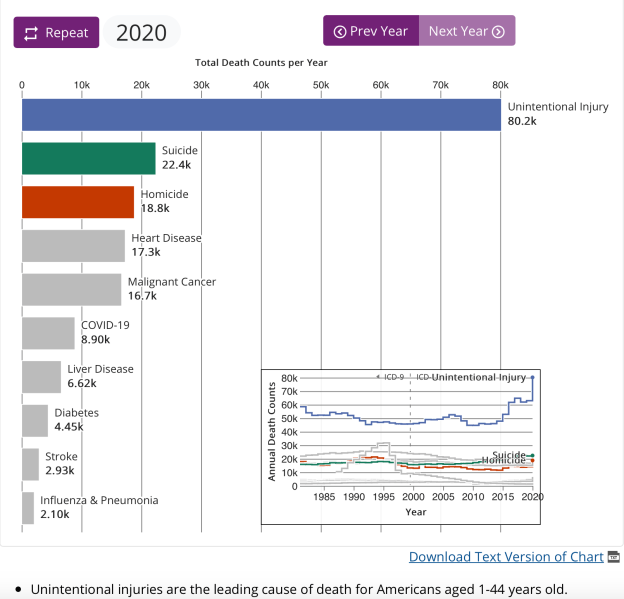
So with injury data we run a little bit behind in terms of what we know. The experts are caught up to what took place and what we learned from the year 2020. That is because this is the most recent year for which complete data is available.

We don’t have all the analysis done for 2021 & we are only nearing the summer solstice and halfway mark of year 2022 as I write this blog post on June 15. Actually it is July 2nd that is the true middle day of the year. July 2 is the 183rd day of the year (184th in leap years) in the Gregorian calendar; 182 days remain until the end of the year, according to Wikipedia.

With regard to the year 2020, it was a bad year, in terms of how the ranks of injury statistics go year by year.

For unintentional injuries, a category which includes opioid overdoses (unintentional poisoning), motor vehicle crashes, and unintentional falls, these unintentional injuries are the leading cause of death for Americans ages 1 – 44. The total number of unintentional injuries for 2020 was 80,200 well above year 2019’s 63,000. Also, suicides which became the second leading cause of death for Americans and steadily on the rise since 2012 reached a grim high in 2020 of 22,4000. And finally homicide as an injury category moved up to the 3rd leading cause of death for this age group with 18,800 recorded in year 2020.

Some key areas of concern for communities drawn from 2020 are:

Opioids overdoses were at their highest level: Opioids were involved in 68,630 overdose deaths in 2020 (74.8% of all drug overdose deaths). In 2020, 45,222 people died from gun-related injuries in the U.S., according to the CDC. The 2020 U.S. gun deaths were up 14% in 1 year, 25% increase from 5 years ago & 43% increase from a decade prior. And car crashes, there were 38,824 fatalities in 2020. The deaths include pedestrians, cyclists and others who may have died during a crash and these are tracked by the National Highway Traffic Safety Administration a Division of the Department of Transportation.

While these numbers are alarming we have to remember there were unique circumstances in 2020 with a global pandemic causing a drastic decline in jobs, rapid unemployment, more time spent isolated at home for many in America, and many cases, hospitalizations, and deaths from COVID-19 virus which traumatized and stressed the entire nation. Looking to the future, I’m optimistic we can learn a great deal from the injury events of 2020 and that the learning can advance injury prevention strategies going forward.

Icebergs & Injuries: How significant are they?

I probably have not thought much about icebergs since the first time I saw the 1997 hit film Titanic, starring Kate Winslet and Leonardo DiCaprio. This movie is dubbed an American epic romance and disaster film directed, written and produced by James Cameron. The film was Cameron’s all time highest grossing film of all time, and winner of 11 motion picture Academy Awards, before later being passed for highest grossing film by Cameron’s other film Avatar.

The film Titanic uses historic facts along with larger than life Hollywood storytelling and special effects to make the RMS Titanic ocean cruise liner ship seem invincible. And for the year 1912 it was a magnificent feat of architectural design, engineering and ship building, and the largest most modern passenger ship at the time of its maiden voyage. Though tragically Titanic met its doom in the early morning hours of April 15, 1912 when the ship’s course could not be altered to avoid striking an iceberg.

The analogy here is the injury problem in America is a lot like an iceberg floating at sea. What you can observe of an iceberg above the water level is really only about one tenth of the total volume of the iceberg. Likewise, the yearly problem of injuries in America is much bigger than most people observe or understand it to be. We spent $4.2 Trillion in the U.S. in total costs to address injuries and their economic impact in 2019.

Unintentional and violence-related injuries, including sui­cide, homicide, overdoses, motor vehicle crashes, and falls, were among the top 10 causes of death for all age groups in the U.S. and caused nearly 27 million nonfatal emergency department (ED) visits in 2019, according to the National Centers for Disease Control & Prevention (CDC). So the tip of this iceberg is likely the $69 billion cost of lost work days as co-workers and colleagues know their workplace and talk with each other and see each other regularly enough to know when someone misses work. One of the less visible layers of the iceberg is the $327 Billion in medical care offered for all those ED visits, some of which become emergency operations and hospital admissions for observations and diagnostic tests. Finally, the largest layer is the loss of productivity and decreased quality of life which CDC experts estimate has a societal and economic impact of $3.8 trillion and more than half of this is attributed to working-aged adults (25 – 64 year olds).  

Though this injury iceberg is bigger than we thought, as was the iceberg in the Titanic’s path, individuals, families, organizations, communities and policymakers can use targeted and proven strategies that prevent injuries and violence to begin to expose and chip away at the challenges that injuries pose. And I can help to consult and guide you on this journey to create a path to fewer injuries where you live and help improve the environment and community you call home along the way as we formalize and work towards your injury prevention goals.   

Preventing Injuries: Save Lives, Save Money

Injuries are a leading cause of death and disability, injuries have impacts at the societal level including economic, health system and injury compensation system. Injuries have impacts on family members, work colleagues and careers. For injured persons body functionality, activity level and participation limitations effect life expectancy and productive contribution potential following injury.